 eKhajana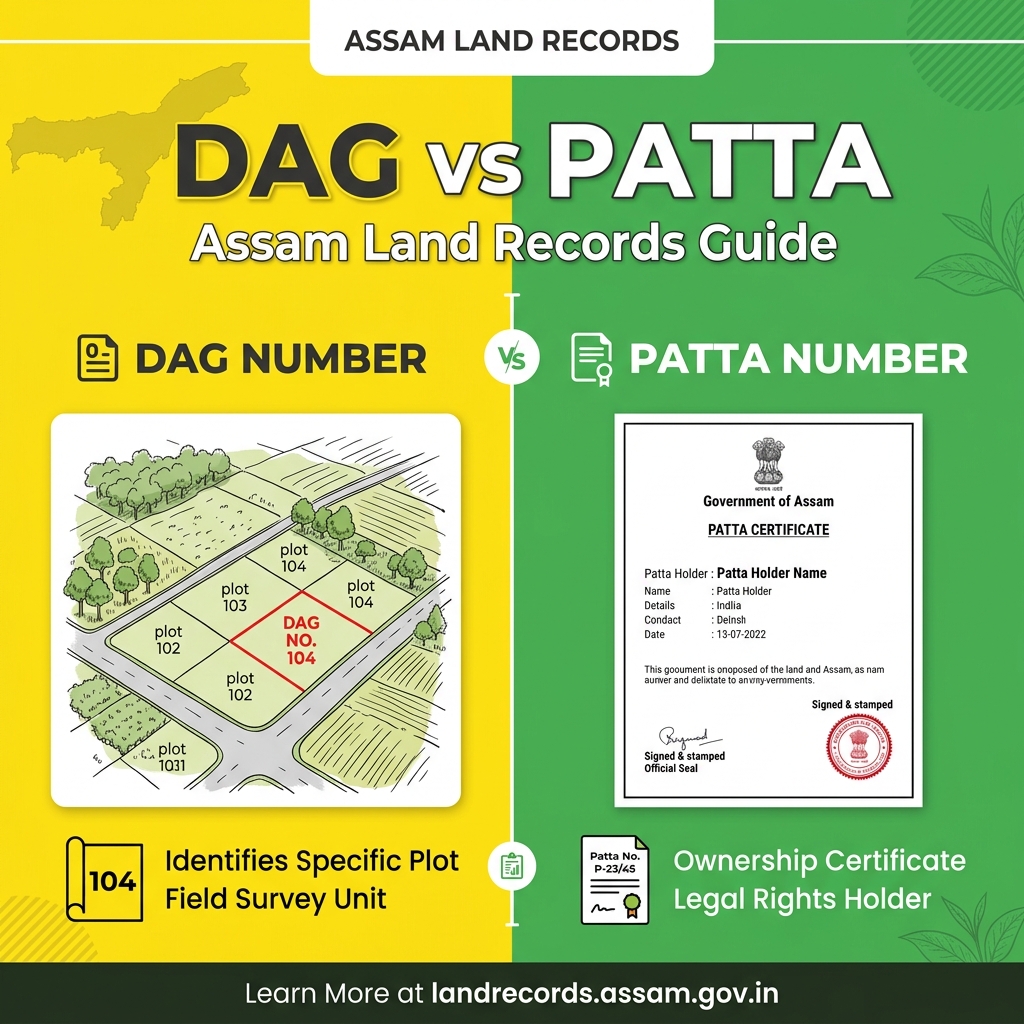
When you buy land in Assam or apply to pay land revenue (e-Khajana) online, you will frequently hear two terms: Dag Number and Patta Number. Many people, especially first-time land buyers, get confused between these two. They often ask: Are they the same thing? If not, what is the difference?
Here I will explain in very simple language what exactly is a Dag number, what is a Patta number, how they differ, and where you can find them on your land documents.
What is a Dag Number?
A Dag Number (also known as Khasra number in other states of India) is a unique parcel identifier or plot number. Think of it like a roll number for your plot of land.
During land surveys, the government maps out every inch of land in a village. To identify each separate plot on the map, they assign a specific number to it. This number is called the Dag number. It helps the land department locate the exact position, boundaries, and size of a specific plot of land on the village map.
The Dag number is tied to the physical location of the land, not to the owner. This means even if you sell the land to someone else, the Dag number stays the same. It only changes if the government re-surveys the village and renumbers the plots, or if the land is officially divided into two smaller plots (in which case each new part gets a new Dag number).
What is a Patta Number?
A Patta Number refers to the land ownership or lease certificate number. While the Dag number identifies the physical plot of land, the Patta number identifies the owner and their lease agreement with the government.
In Assam, the government issues a document called a "Patta" to the landowner, which acts as a legal proof of leasehold or ownership rights. The document contains a unique identification number, which is your Patta number. One Patta can cover multiple Dag numbers if a single person owns different land plots in the same village.
When land is sold and mutation (Namjari) is done, the old owner's Patta is cancelled and a new Patta is issued to the new owner. The Dag number(s) of the land remain the same, but the Patta number changes to reflect the new owner's lease certificate.
Key Differences: Dag Number vs Patta Number
| Feature | Dag Number | Patta Number |
|---|---|---|
| Meaning | Identifies the physical plot of land on the village map. | Identifies the legal lease/ownership certificate. |
| Nature | Permanent geographical number (unless land is divided). | Can change when ownership is transferred or mutated. |
| Scope | Applies to one specific plot of land. | Can contain multiple plots (Dags) owned by the same person. |
| Purpose | Used to locate the land boundaries and area. | Used to identify the legal title and tax liabilities. |
| Changes on Sale | No, stays the same. | Yes, a new Patta is issued to the buyer. |
Types of Patta in Assam
In Assam, you will mostly find two types of land Patta:
- Myadi Patta (Periodic Patta): This is a permanent land lease granted by the government, usually valid for 30 years and automatically renewed. Landowners of Myadi Patta have full rights to transfer, sell, or mortgage their land.
- Eksonia Patta (Annual Patta): This is a temporary lease granted for one year. Landholders of Eksonia Patta cannot sell or transfer the land to others. To sell it, you must first convert the Eksonia Patta into Myadi Patta by applying at the circle office.
Additionally, in tribal belts and blocks, you may encounter Tribal Patta, which comes with restrictions on transferring to non-tribal citizens. In some government-allotted lands, you may also see Settlement Patta or Patowary Land documents.
How to Find Your Patta and Dag Number?
You can easily find these numbers by looking at your old land documents:
- Land Revenue Receipt (Khajana Rashid): Check your previous physical or online Khajana receipts. The Patta number and Dag number are always printed clearly on the top left or middle section.
- Jamabandi (Record of Rights): Download your Jamabandi copy from the Dharitree portal. It lists all Dag numbers and the current Patta number associated with your land.
- Deed of Sale (Bikri Kabala): Your land purchase agreement lists the exact Dag and Patta numbers of the land you bought.
- Original Patta Document: If you received a physical Patta certificate from the circle office, the Patta number is printed prominently at the top of the document.
If you still cannot locate them, you can take your village name and visit the local Lot Mandal office. The Mandal can search the village field book (Chitha) and find your numbers in a few minutes.
Why are Dag and Patta Numbers Important for e-Khajana?
When you apply to pay your annual land revenue (e-Khajana) online on the Sewa Setu portal, you must enter your Patta number and Dag number to identify your land parcel. The system uses these numbers to pull your land records from the Dharitree database, verify your ownership, calculate the applicable tax rate, and generate a payment demand. Without these numbers, you simply cannot initiate an e-Khajana payment online.
This is why knowing your Dag and Patta number is the first and most critical step in managing your land in Assam. Keep these numbers noted in a safe place — your phone notes, a diary, or a photo of your Khajana receipt saved in cloud storage.
Common Problems & Troubleshooting
- Multiple Dag numbers under one Patta: This is normal and happens when one person owns multiple plots in the same village. All Dags are listed in one Jamabandi document.
- Patta number not matching after land purchase: After you buy land and get mutation done, the old seller's Patta number is cancelled. You receive a new Patta number. Always use your new Patta number for future transactions.
- Cannot find your Dag on Dharitree: Very old or disputed lands sometimes have missing or conflicting records. In such cases, visit the circle office and request a manual search of the village field book (Chitha).
- Different Dag numbers in old and new receipts: This can happen if the village was re-surveyed and plots were renumbered. Your Lot Mandal can clarify which old Dag corresponds to which new Dag.
Pro Tips
- Always write your Patta number and all Dag numbers on the inside cover of your land document folder for quick reference.
- If you own land in multiple villages, keep a separate note for each village as Dag numbers are village-specific and can overlap.
- When buying land, always verify the seller's Patta number on the Dharitree portal before signing the sale deed to confirm they are the genuine owner.
- Take a photo of the relevant page in your Khajana receipt that shows your Patta and Dag number and save it in your email or Google Drive.
Frequently Asked Questions
Q: Can one Dag number have two owners?
Yes, if the land is jointly owned (for example, inherited by brothers), one Dag number can have multiple co-owners. In such cases, the Jamabandi will list each owner's name along with their fractional share (e.g., 1/2, 1/3) of the total land area.
Q: Can the Dag number change over time?
A Dag number is generally permanent for the lifetime of the plot. However, it can change if the land is officially partitioned into smaller plots (each gets a new Dag number), or if the government conducts a new village cadastral survey and reassigns plot numbers.
Q: My old receipt shows a Dag number, but it doesn't appear on Dharitree. Why?
There are two likely reasons: either your village's records have not been digitized yet, or the Dag number was changed after a subsequent re-survey. Visit your local Lot Mandal's office with the old receipt to get the updated Dag number.
Q: What is the difference between Dag and Khasra number?
They are the same concept called by different names in different states. In Assam, it is called the Dag number. In states like Uttar Pradesh, Madhya Pradesh, and Rajasthan, the equivalent is called the Khasra number. Both refer to a unique identifier for a physical land parcel on the village map.
Q: Do I need a Patta number to check Jamabandi?
No, you can also search for your Jamabandi using just the Dag number or even the owner's name on the Dharitree portal. However, having the Patta number makes the search faster and more precise, especially in large villages with common names.
Q: After buying land, how long does it take to get a new Patta number?
After your mutation (Namjari) application is approved by the Circle Officer, the new Patta number is generated within 7 to 15 working days and becomes searchable on the Dharitree portal.
Conclusion
Understanding the difference between a Dag number and a Patta number is the foundation of managing your land in Assam. The Dag identifies where your land physically is, while the Patta identifies who legally owns it. Keeping these numbers handy and verifying them on the Dharitree portal regularly will save you from unnecessary trips to the circle office and protect your ownership rights. Whether you are paying Khajana, applying for a loan, or buying new land, always start by confirming your correct Dag and Patta numbers.
Practical Examples of Dag and Patta Numbers
Let's look at a practical scenario to make this clear. Imagine you buy three separate small plots of land in the same village from the same person. Each of these three plots will have a unique physical identifier, which is the Dag Number (e.g., Dag 101, Dag 102, and Dag 103). However, since you are the single owner of all three plots under a single lease agreement, the government may issue you a single periodic lease certificate, which is the Patta Number (e.g., Patta 45).
This means your single Patta Number 45 will list all three Dag Numbers (101, 102, 103). This is why one Patta can contain multiple Dags, but one Dag cannot belong to multiple Pattas unless it is joint ownership.
Frequently Asked Questions
Q: Can a Dag number change over time?
A: Generally, a Dag number remains permanent unless the plot is officially divided (partitioned) or a new land resettlement survey is conducted in the village by the government.
Q: Can a Patta number have more than one Dag number?
A: Yes, a single Patta number can list multiple Dag numbers if the same landowner owns multiple plots of land in the same village.
Q: What is the difference between a Periodic Patta and an Annual Patta?
A: A Periodic Patta (Myadi) is a permanent 30-year lease that gives full ownership rights, while an Annual Patta (Eksonia) is a temporary 1-year lease that cannot be sold or transferred.
Q: What should I do if my land tax receipt shows the wrong Dag number?
A: You should immediately contact your local Lot Mandal with your registered land deed and old tax receipts to get the record corrected in the field book (Chitha).
Q: Is it safe to buy land that only has an Annual (Eksonia) Patta?
A: No, it is not legally safe because selling annual patta land is strictly prohibited by law in Assam. You must ask the seller to first convert it into Myadi Patta before buying.