 eKhajana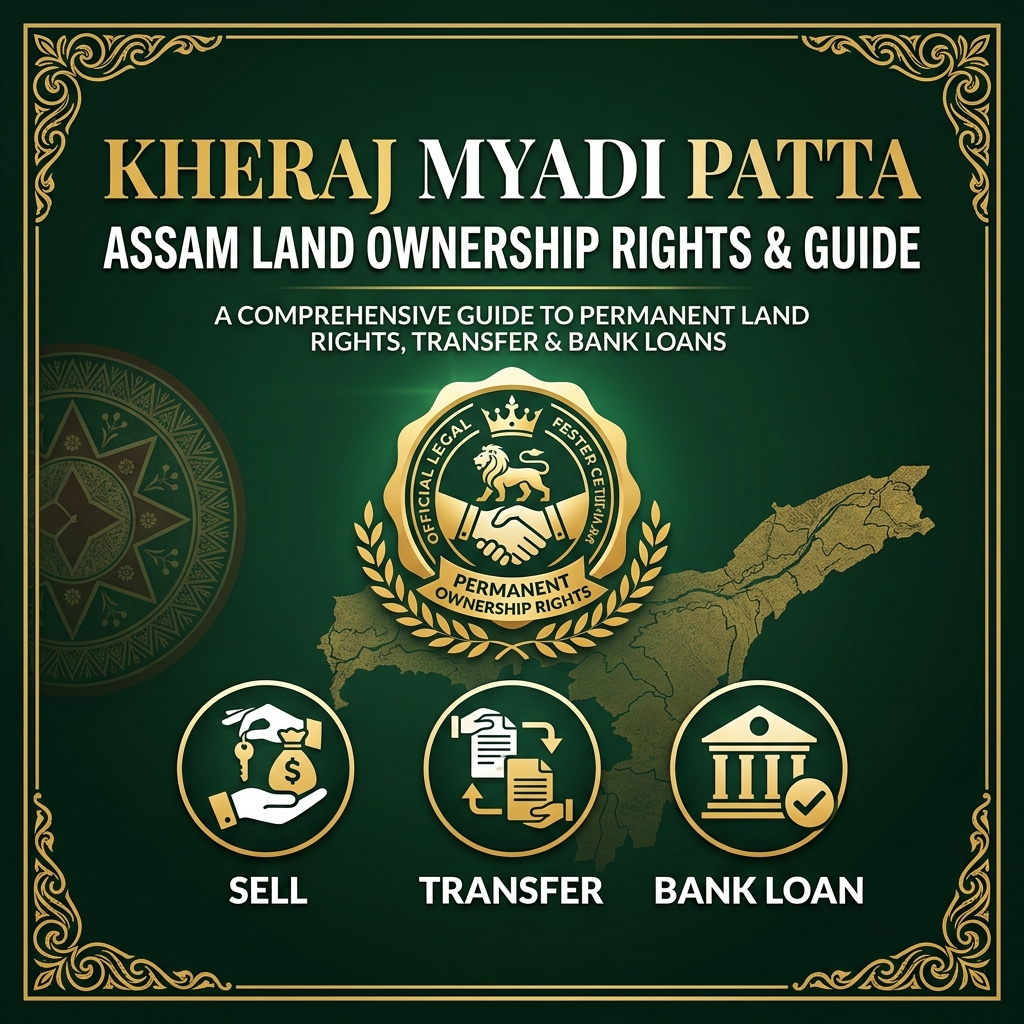
If you own land in Assam or are planning to buy a plot, you will often see the term Kheraj Myadi Patta on the land document (Jamabandi). It is the most common land ownership status in Assam. But what does it actually mean, and what rights do you get under it?
Here, I will explain Kheraj Myadi Patta in simple, non-legal words so you can easily understand your land rights.
Breaking Down the Term
To understand the meaning, let us break down the words:
- Kheraj: In old Arabic and revenue terms, Kheraj means land revenue or land tax. In Assam, it indicates that the land is subject to annual tax payment to the government treasury.
- Myadi: This word means "periodic" or having a fixed term. In Assam's land system, a Myadi Patta is a lease granted for a long periodic term (typically 30 years).
- Patta: A legal document issued by the government certifying land leasehold or ownership.
So, a Kheraj Myadi Patta is a periodic land lease issued by the government, subject to annual land revenue payments.
The Legal Basis of Kheraj Myadi Patta
The Kheraj Myadi Patta system is governed by the Assam Land and Revenue Regulation, 1886. Under this regulation, the Government of Assam grants long-term leases to citizens for agricultural, residential, and commercial use. While technically a lease (the land ultimately belongs to the state government), a Kheraj Myadi Patta gives the holder all practical ownership rights over the land.
This system is similar to freehold ownership in practice. The government rarely reclaims Myadi Patta land except for large public infrastructure projects (like highways or railways), and in those cases, the holder receives full compensation based on the market value of the land.
Rights of a Kheraj Myadi Patta Holder
A periodic Myadi Patta landowner enjoys almost full ownership rights over the land. Under the Assam Land and Revenue Regulation 1886, you get these rights:
- Right to Sell or Transfer: You can legally sell, gift, or transfer your Myadi land to any eligible citizen of Assam without needing permission (except in protected tribal blocks or belts).
- Inheritance Rights: After the death of the owner, the land automatically transfers to their legal heirs through mutation (Namjari).
- Right to Mortgage: You can submit your Myadi land Patta to nationalized or private banks to get agricultural, business, or home loans.
- Permanent Lease Renewal: Although it is a 30-year lease, it is automatically renewed by the revenue department upon expiry. The government cannot take back your land unless it is required for public infrastructure projects, in which case you receive full financial compensation.
- Right to Develop: You can construct buildings, dig wells, plant trees, or develop the land for agricultural or residential purposes without seeking special permissions (subject to local building bylaws).
- Right to Sub-Lease: In most cases, you can lease out the land to tenant farmers or sub-tenants, provided you comply with local tenancy laws.
What Happens if You Don't Pay Khajana on Kheraj Myadi Land?
Failure to pay land revenue on Kheraj Myadi Patta can have serious consequences:
- The government can issue a defaulter notice through the revenue circle office.
- Accumulated unpaid Khajana, along with a penalty, becomes payable before you can do any land transaction.
- In extreme cases of prolonged non-payment, the government can serve a notice for land resumption proceedings, though this is rare in practice.
- You will not be able to sell or mortgage the land until all dues are cleared and you have an up-to-date Khajana receipt.
Kheraj Myadi vs. Other Land Types in Assam
To fully understand Kheraj Myadi Patta, it helps to compare it with other land tenure types in Assam:
- Kheraj Myadi Patta: Full rights, taxable, transferable, 30-year periodic lease (automatically renewed). Most common type.
- Eksonia (Annual) Patta: Temporary 1-year lease, cannot be sold or mortgaged, government can resume without compensation.
- Nisfkhiraj Land: Partially revenue-paying land, mostly found in older survey records and tea garden areas.
- Lakhiraj Land: Revenue-free land historically granted to religious institutions (temples, mosques) or for specific charitable purposes.
- Tribal Patta (in tribal blocks/belts): Land restricted to tribal citizens, cannot be transferred to non-tribal persons.
How to Verify If Your Land Is Kheraj Myadi?
You can verify your land type by downloading your Jamabandi from the Dharitree portal (revenueassam.nic.in/dhar/). In the Jamabandi, look for the column that shows the Patta type. If it says "Kheraj Myadi" or "Periodic", your land is of this type. If it says "Eksonia" or "Annual", it is a temporary lease and you should apply to convert it to Myadi under Mission Basundhara.
Common Problems & Troubleshooting
- Jamabandi shows Eksonia but I thought my land was Myadi: This can happen if the original settler did not convert the land type. Apply for Eksonia-to-Myadi conversion under Mission Basundhara immediately to protect your rights.
- Bank refused my Myadi Patta for a loan: This may happen if your Jamabandi shows unpaid Khajana or name mismatch. Clear all dues and ensure your name is correctly reflected in the records before applying again.
- Land in tribal belt shows as Myadi but was sold to a non-tribal: Such sales are invalid under the law. Consult a revenue lawyer immediately as this can lead to government resumption of the land.
Frequently Asked Questions
Q: Can I sell Kheraj Myadi Patta land to anyone?
Yes, you can sell Kheraj Myadi Patta land to any eligible citizen of Assam. However, if the land is located in a tribal belt or block, it can only be sold to another tribal citizen. In non-tribal areas, there are no restrictions on who you can sell to, but both buyer and seller must complete the legal registration at the Sub-Registrar office.
Q: Is Kheraj Myadi Patta permanent ownership?
While legally it is a long-term lease (30 years), it is automatically renewed and is considered permanent for all practical purposes. The government very rarely reclaims Kheraj Myadi Patta land, and if it does for public projects, full compensation at market rate is mandatory.
Q: What is the difference between Kheraj Myadi and Nisfkhiraj Myadi?
Kheraj Myadi Patta is fully revenue-paying land where the holder pays the full annual tax rate. Nisfkhiraj Myadi Patta is a partially revenue-paying land where only half the normal tax rate applies. Nisfkhiraj lands were historically granted at concessional rates and are now rare.
Q: Do I need to renew my Myadi Patta after 30 years?
No, the renewal of Myadi Patta is done automatically by the Revenue Department upon expiry. You do not need to submit any renewal application or pay any renewal fee. The Patta remains valid as long as you continue to pay annual Khajana.
Q: Can I build a house on Kheraj Myadi Patta agricultural land?
If your Kheraj Myadi Patta is classified as agricultural land (Rupit or Faringati), you technically need to apply for a land reclassification to convert it to residential (Basti) before constructing a house. This can be done under Mission Basundhara's land reclassification service.
Q: How much does Kheraj Myadi land cost in Assam?
The price of Kheraj Myadi Patta land varies enormously based on location, land class, and accessibility. In rural Assam, agricultural land can range from Rs. 1 lakh to Rs. 10 lakh per bigha. In urban and peri-urban areas, residential Myadi land near Guwahati or Dibrugarh can go from Rs. 10 lakh to Rs. 1 crore or more per katha.
Conclusion
Kheraj Myadi Patta is the most secure and valuable type of land ownership in Assam. It gives you near-permanent rights to use, sell, mortgage, and inherit the land. The only obligation is to pay your annual Khajana to the government — a small amount that protects your legal title. If your land is currently under Eksonia Patta, converting it to Kheraj Myadi Patta under Mission Basundhara should be your immediate priority to secure your family's land rights.
Important Ownership Rules for Myadi Patta
While Myadi Patta gives you near-complete ownership, you must be aware of certain legal regulations:
- Protected Belts and Blocks: If your Myadi land is located in a protected tribal block or belt of Assam, you cannot sell or transfer it to any non-tribal person, even if it is periodic land.
- Land Acquisition: Under the Land Acquisition Act, the government has the right to acquire any land (including Myadi Patta) for public infrastructure like highways, railways, or dams, but they must pay you the full market value as compensation.
- Land Use Restrictions: You cannot use agricultural Myadi land for commercial or industrial purposes without obtaining a Land Reclassification Certificate from the Circle Officer.
Frequently Asked Questions
Q: Can I sell Kheraj Myadi land easily?
A: Yes, Myadi land can be sold, gifted, or transferred to any eligible citizen of Assam through a registered sale deed. You must apply for a land sale permission online first.
Q: How long is the lease period of Kheraj Myadi Patta?
A: The lease is periodic, usually granted for 30 years, and it is automatically renewed by the revenue department upon expiry.
Q: Can I get a home loan against Myadi Patta land?
A: Yes, all nationalized and private banks accept Kheraj Myadi Patta land as a valid collateral security for home, business, or crop loans.
Q: What is the difference between Kheraj and Nisf-Kheraj?
A: Kheraj refers to full-revenue paying land, whereas Nisf-Kheraj refers to half-revenue paying land, which was historically granted to religious or charitable institutions.
Q: Can the government cancel my Myadi Patta?
A: The government can cancel it only in rare cases of lease violation, failure to pay land revenue for many years, or if the land was obtained through fraud.