 eKhajana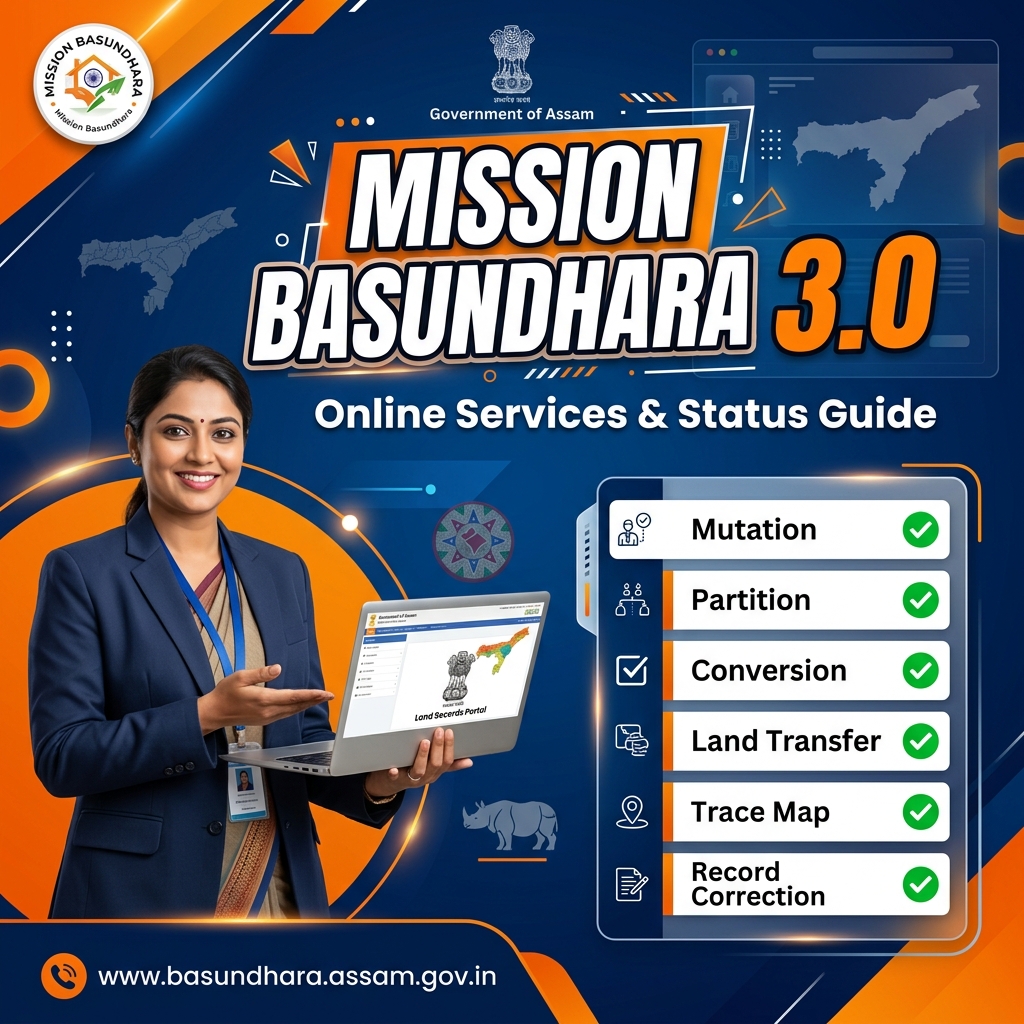
If you live in Assam and have ever dealt with land issues, you must have heard of Mission Basundhara. Launched by Chief Minister Shri Himanta Biswa Sarma, Mission Basundhara is a historic land reform scheme aimed at simplifying land services, resolving disputes, and cleaning up land records across the state.
Here, I will explain what Mission Basundhara is, the differences between Basundhara 1.0, 2.0, and 3.0, the services you can apply for, and how to check your application status online. Let's dive in.
Why Was Mission Basundhara Launched?
Before Mission Basundhara, getting basic land services done in Assam was a nightmare for ordinary citizens. A simple mutation (Namjari) could take months or even years. Citizens had to bribe middlemen, make repeated trips to circle offices, and navigate complex paperwork just to get their name added to the government's land register after purchasing land.
The Assam government identified that over 30 lakh land-related applications were pending across all revenue circles in the state. Disputes, encroachments, and fraud were rampant due to unverified and outdated paper-based records. Mission Basundhara was the government's bold answer to this systemic failure — a time-bound, digital, and transparent land services campaign.
The Journey of Mission Basundhara
To eliminate corruption, middle-men, and delays in land offices, the Assam government launched Mission Basundhara in phases:
1. Mission Basundhara 1.0
Launched on October 2, 2021, this phase was focused on clearing pending land mutation (Namjari) cases, land partitioning, updating land names, and re-surveying villages. It closed after successfully resolving over 8 lakh applications in a time-bound manner. Citizens could apply at Common Service Centres (CSCs) across Assam. The goal was to process each application within 15 days, compared to the years-long delays under the old system.
2. Mission Basundhara 2.0
Launched on November 14, 2022, this phase went a step further by offering land ownership rights (Patta) to indigenous people of Assam, including tribal communities and people living on government land for generations. It allowed citizens to apply for settlement of government land, conversion of annual patta to periodic patta, and settlement of land in town areas. This phase gave permanent land rights to thousands of landless poor families who had been farming or living on land for decades without legal title.
3. Mission Basundhara 3.0
Launched in late 2024 / early 2025, this current phase aims to resolve left-out land settlement cases, simplify digital maps, digitize tea garden land records, and make online land revenue (e-Khajana) payments fully integrated. It focuses on absolute transparency and complete digital access for landowners. This phase also introduced digitally signed Pattas that can be downloaded directly from the Sewa Setu portal — eliminating the need for citizens to visit the circle office to collect physical documents.
Key Services Offered under Mission Basundhara
Citizens of Assam can apply online for the following land services through the Basundhara portal:
- Mutation (Namjari): Transferring land records to the new owner's name after buying or inheriting land.
- Partition of Joint Patta: Dividing a single joint land document (Patta) among co-owners so that everyone gets a separate Patta for their share.
- Conversion of Eksonia to Myadi: Converting one-year temporary land leases (Annual Patta) into permanent 30-year leases (Periodic Patta).
- Re-classification of Land: Changing the official land class (e.g., agricultural land to residential land).
- Striking out names: Removing names of deceased persons or illegal entries from the land Patta.
- Area Correction: Correcting errors in the recorded land area of your plot.
- Name Correction: Fixing spelling mistakes in owner or guardian names in the Jamabandi.
- Land Settlement for Landless: Granting new Patta rights to eligible landless indigenous citizens.
How to Apply for Services under Mission Basundhara?
Citizens can apply in two ways:
- Online via Portal: Visit https://basundhara.assam.gov.in, log in with your mobile and Aadhar OTP, select the service, fill the form, upload documents, and submit.
- At CSC / Arunodoi Kendras: Visit your nearest Common Service Centre (CSC) or Arunodoi Kendra and ask the operator to help you apply. The operator will fill and submit the form on your behalf and provide you an acknowledgment receipt.
After submission, the application goes through three stages: verification by the Lot Mandal, review by the Circle Officer, and final approval. For many services, you can also download the digitally signed output document directly from Sewa Setu once approved.
How to Track Mission Basundhara Application Status?
Once you apply for any land service under Mission Basundhara at a CSC center or online, you will receive an acknowledgment receipt containing an RTPS Application Reference Number (e.g., RTPS/MUBAS/XXXX/XXXX).
You can track the live progress of your application by following these steps:
- First, visit the official website: https://basundhara.assam.gov.in.
- On the top navigation menu, click on the Track Application Status option.
- Enter your RTPS Application Reference Number in the box.
- Click on the Track or Search button.
- Your current status (e.g., Pending with LM, Pending with Circle Officer, Approved, or Disposed) will appear on your screen.
If your status shows "Disposed" and it says approved, it means your land records have been successfully updated. You can now download your new Jamabandi or proceed to make your online Khajana payment on the Sewa Setu portal. If it says rejected, check the reason provided by the Circle Officer and re-apply with the required documents.
Documents Commonly Required for Mission Basundhara Applications
While the exact documents vary by service type, you will generally need:
- Aadhar Card of the applicant (mandatory for all services).
- Latest Land Revenue Receipt (Khajana Rashid).
- Registered Sale Deed or Inheritance Documents (for mutation).
- Copy of the existing Jamabandi / Patta.
- Passport-size photograph of the applicant.
- NOC or consent of co-owners (for partition applications).
Common Problems & Troubleshooting
- Application stuck with Lot Mandal for months: If pending more than 30 days, visit the Circle Office directly with your acknowledgment receipt and request the CO to expedite the Lot Mandal's verification.
- Application rejected without clear reason: Log in to the portal and check the rejection remarks entered by the officer. Common reasons are missing documents, boundary disputes, or name mismatches.
- OTP not received for Aadhar verification: Make sure your current mobile number is linked to your Aadhar. If not, visit the nearest Aadhar Seva Kendra to update your mobile number.
- Portal showing error during submission: Try clearing browser cache, switching to Chrome or Firefox, or using a different internet connection (mobile data instead of WiFi).
Frequently Asked Questions
Q: Is Mission Basundhara still accepting applications in 2025?
Yes, Mission Basundhara 3.0 is currently active as of 2025. Citizens can apply online at basundhara.assam.gov.in or through their nearest CSC. The government periodically announces new application windows, so check the official website or local news for updates.
Q: How much does it cost to apply under Mission Basundhara?
Most basic services like Namjari, name correction, and area correction are free or carry a nominal application fee. However, for land settlement and Eksonia-to-Myadi conversion, you will need to pay a Land Premium based on the government's zonal valuation of your land.
Q: Can I apply for multiple services in one application?
No, each service requires a separate application on the Mission Basundhara portal. For example, if you need both a name correction and a partition, you must submit two separate applications and track two separate RTPS reference numbers.
Q: What happens after my Namjari is approved under Basundhara?
Once Namjari is approved, the Dharitree database is updated with your name. You can download your updated Jamabandi from the Dharitree portal. You can then register for e-Khajana on Sewa Setu and start paying your annual land revenue online.
Q: What if the land I want to settle has encroachments or disputes?
Applications for land with active disputes or encroachments are put on hold until the dispute is resolved. You should first settle any encroachment issues through the Circle Officer or Sub-Divisional Officer before applying for settlement under Mission Basundhara.
Conclusion
Mission Basundhara is one of the most significant land reforms in Assam's history. It has digitized and simplified processes that used to take years and significant bribes. If you have any pending land issues — whether it's Namjari, Eksonia to Myadi conversion, land partition, or corrections in your Jamabandi — Mission Basundhara is your best opportunity to resolve them quickly and legally. Visit the official portal, apply online, and track your status regularly. A clean and clear land record protects your family's future.
Details of Services in Mission Basundhara 3.0
The latest phase, Mission Basundhara 3.0, introduces advanced digital workflows to further minimize human interface. The core focuses include:
- Digital Cadastral Maps: Linking of land records with spatial maps (GIS mapping) to define exact boundaries and prevent disputes.
- End-to-End Online Fee Payment: Citizens can pay mutation premiums and other fees directly using integrated GRAS payment gateways, receiving instantaneous receipts.
- SMS Updates: Real-time tracking alerts sent to the registered mobile number of the applicant at each stage of the approval process.
Frequently Asked Questions
Q: What is the official website for Mission Basundhara?
A: The official portal is https://basundhara.assam.gov.in. You can apply for all services and track applications here.
Q: What are the charges for applying under Mission Basundhara?
A: The initial application fee is very nominal (around Rs. 50 to Rs. 100). However, if your application for land settlement or conversion is approved, you will have to pay the applicable land premium fees online, which depend on the land classification and area.
Q: How long does it take for a mutation to be approved under Basundhara?
A: The government has mandated a time-bound service delivery. Most standard mutation applications are resolved within 30 to 45 days, provided all uploaded documents are correct and the field verification is clear.
Q: Can non-indigenous people apply for land settlement?
A: No, land settlement under Mission Basundhara is strictly reserved for indigenous communities and citizens who meet the specified domicile criteria of Assam.
Q: What should I do if my Basundhara application is rejected?
A: Check the reason for rejection in the tracking status window. If it is due to missing or unclear documents, you can re-apply on the portal with the corrected documents.